Tag: 20th century

Cry of the Andes

Cry of the Andes

The Devilphone

The Devilphone

Alistair's avatarADOXOBLOG

Devilphone

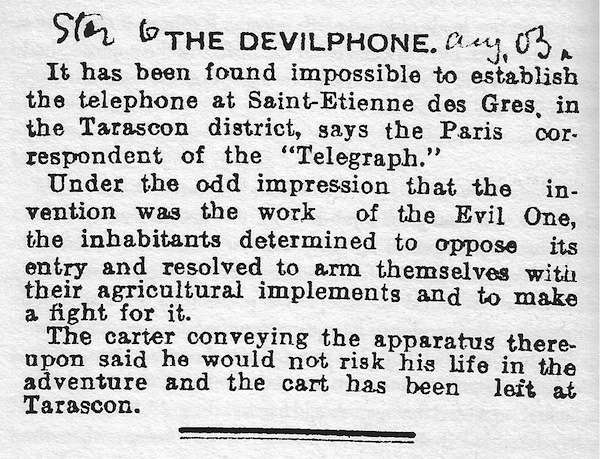
Newspaper clipping from 1903, reporting that the entire village of Saint-Etienne des Gres regarded the telephone as Satanic and refused to have anything to do with it. “… the inhabitants determined to oppose its entry and resolved to arm themselves with their agricultural implements and to make a fight for it.” Hollywood style villagers with pitchforks, for real!

And this is how angry they were before any of them could possibly have needed to phone an Indian call centre. Those really are the work of the Evil One.

View original post

Say yes I will yes to Bloomsday

Say yes I will yes to Bloomsday

Alistair's avatarADOXOBLOG

Today, the 16th of June, is Bloomsday: the annual celebration of the life and work of James Joyce in general, and of his landmark Modernist novel Ulysses in particular. It’s a landmark in the literary sense and also in the geographical sense, a dauntingly huge and dense wodge of cellulose. If ever a book was better read weightlessly as an e-book, Ulysses is it. June 16th 1904 is the Dublin day described in hyperreal detail by the book’s protagonist Leopold Bloom, and re-enacted by Joyce fanatics every year since 1954.

The 16th of June was also significant as the date of Joyce’s first outing with the woman who would become his beloved wife, Nora Barnacle. So why don’t you celebrate Bloomsday by starting on Ulysses if you haven’t already? To be honest you might regret it and give up in frustration as many have done before, but you definitely won’t…

View original post 237 more words

Are you pyknický?

Are you pyknický?

Alistair's avatarADOXOBLOG

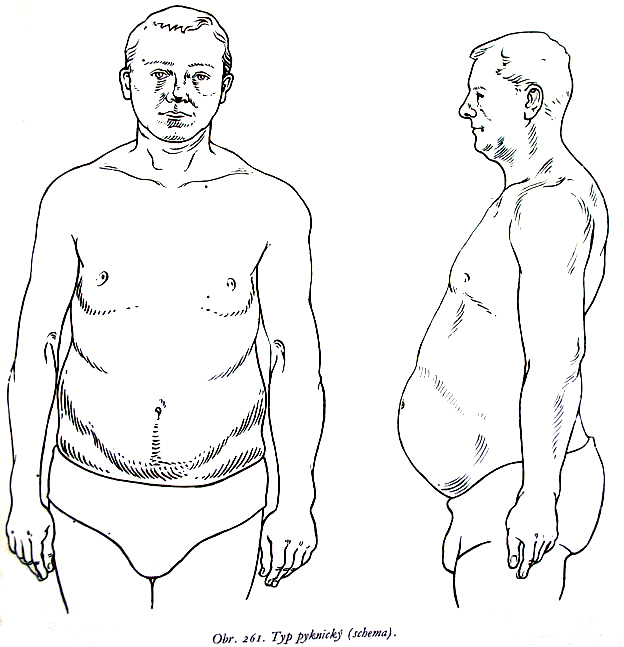
More hard drive detritus! I’ve cleaned the images up a lot, because the originals look like somebody–definitely not me– just snapped the pages from some kind of text book. Nothing so methodical or high tech as a scan. As usual I don’t know where these slightly unnerving pictures came from. My highly scientific detective work (playing around with Google Translate for a while) led to the conclusion that the captions are in Slovakian. The drawing of various faceless nude people (last image on this page) has a bit of a prison camps behind the Iron Curtain vibe. Hard to tell the age of them. The somatotype thing came to prominence in the 1940s and 1950s, so presumably these illustrations are from that period or slightly later.

Also as usual, corrections or additional information are welcome.

Typ pyknický presumably means endomorphic type, i.e. prone to fatness, but I like to…

View original post 73 more words

Large Papier Mache Heads

Large Papier Mache Heads

Alistair's avatarADOXOBLOG

demoulin_catalog_cover

“To be worn over head and rest on shoulders. Full size. Fine natural painted. Heads kept in stock can be shipped on short notice.”

Freemasons: plotting in secret to run the world and conceal an age-old conspiracy, or getting drunk and running around wearing a donkey head? On the evidence of this old catalogue of “Burlesque and Side Degree Specialties, Paraphernalia and Costumes” by De Moulin Bros. & Co., I’m afraid the latter scenario seems much more likely. Sorry, conspiracy fans.

OR MAYBE I’M A NWO REPTOID TOO AND I’M IN THE PAY OF THE ILLUMINATI. STAY ASLEEP.

This is more hard drive detritus. I don’t know where these images came from or why I originally stored them. I know only that they’re from late 2001 or early 2002, and they therefore predate the books or sites that came out over the past few years with nutty material from…

View original post 248 more words

Unscary Monsters

Unscary Monsters

Alistair's avatarADOXOBLOG

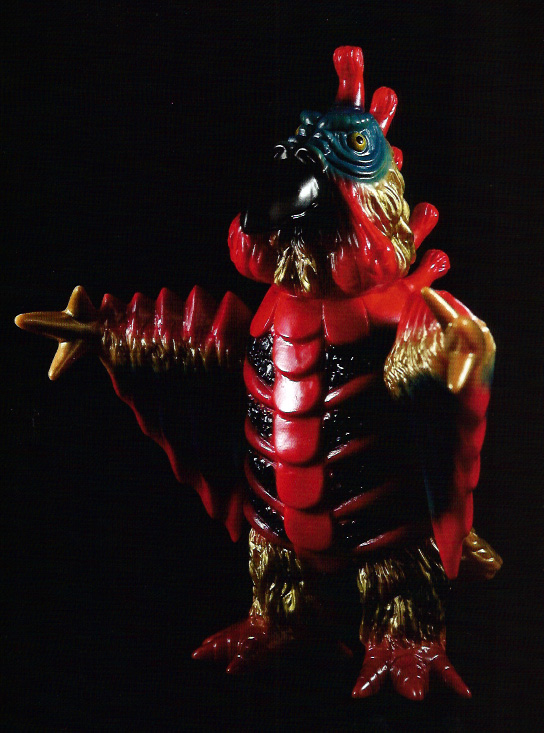
I don’t know much about Ultraman or the context of the characters depicted here, except that it was a Japanese tokusatsu (特撮 “special effects”) TV series from the 1960s involving battles between the title character and various kaiju (怪獣 usually translated as “giant monster”, though it’s more like “strange monster”) of the kind best known to Western audiences in the form of Godzilla. It still looms fairly large in Japanese culture via various spinoffs, sequels, reboots and vinyl figures based on characters from the show. I got a catalogue of the figures in Tokyo a few years ago, mainly because I liked the pathos of these endearingly crappy monsters. On the other hand, I suppose even Pigmon would be legitimately terrifying if it was really the size of a building and it came crashing down onto your house.

In classic Japlish style the book’s katakana title reads as something like…

View original post 49 more words

Doomed

Doomed

Alistair's avatarADOXOBLOG

“Why worry so much about the future of a doomed world?”

Doomed

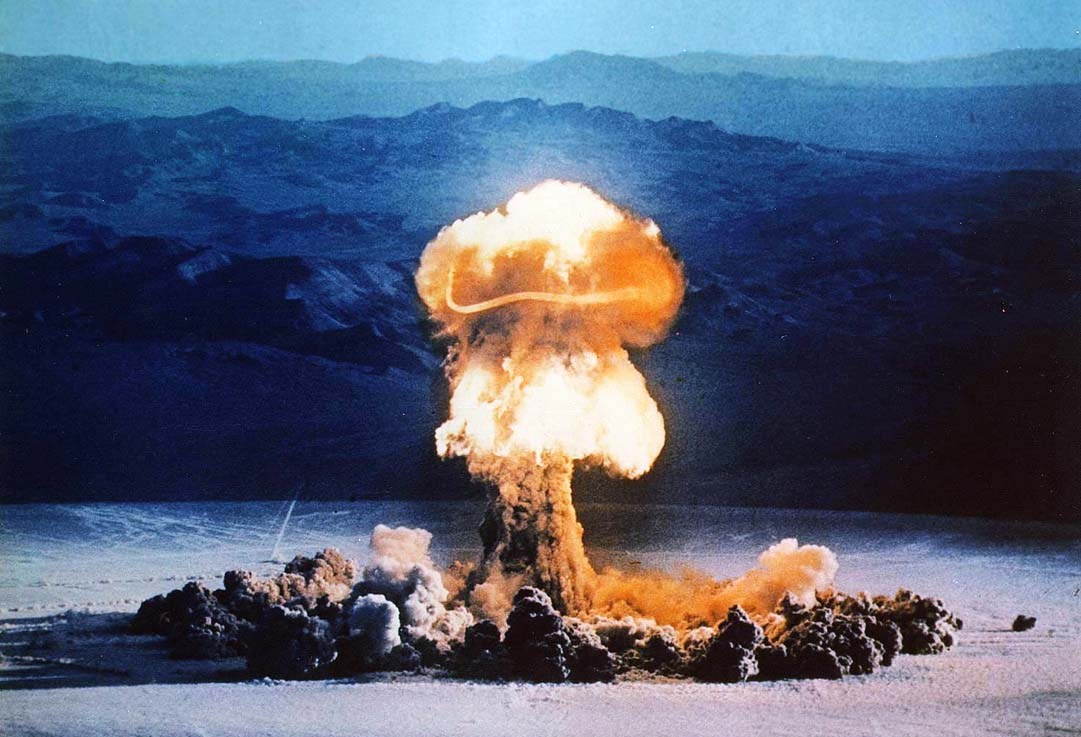
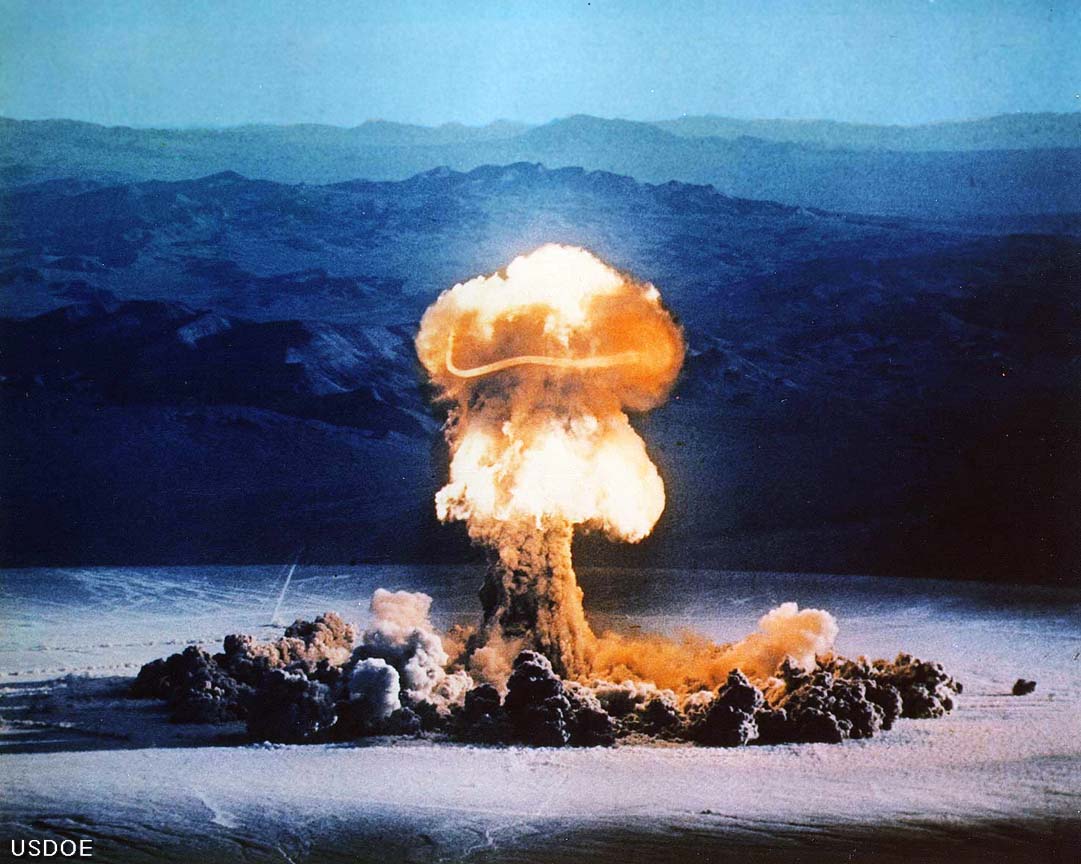
A delightfully nihilistic quote attributed to physicist J. Robert Oppenheimer, one of the main architects of the Manhattan Project and of the first atomic weapons, although it’s probably apocryphal. It seems to originate in French from Michel Houllebecq’s book H.P. Lovecraft: Against the World, Against Life. The English translation of Houllebecq actually mentions in a footnote that the quote is untraceable.

Houllebecq is, shall we say, a not uncontroversial writer who may conceivably be projecting his own profound misanthropy and negativity onto Oppenheimer; Lovecraft’s, too. Even so, it’s in character for a man who made it possible for the human race to render itself and most other life on the planet totally extinct within a matter of minutes.

It’s also in character for Marvin the Paranoid Android from The Hitchhiker’s Guide to the Galaxy. “The first ten million…

View original post 34 more words

Eric Gill, sans consentement

Eric Gill, sans consentement

“‘Bath and slept with Gladys,’ runs one entry in the diary. Such Gill family intimacies seem routine, a habit. A few weeks later there are more surprising entries; ‘Expt. [experiment] with dog in eve’ [the rest has been obliterated]. Then, five days later, ‘Bath. Continued experiment with dog after and discovered that a dog will … Continue reading Eric Gill, sans consentement

V

V

Alistair's avatarADOXOBLOG

The last scans for now from an excellent but sadly out of print book called The Public Notice. The Channel Islands, including Jersey, were the only part of Britain occupied by the Germans during World War II, from summer of 1940 until May of 1945. Even though the Channel Islands are some distance away from mainland Britain, they’re technically spoken of as being among the British Isles. These proclamations (both 1941) give some intimation of a nightmare scenario where the Nazis won and the rest of Britain fell permanently to the Third Reich; a place where a man would be summarily shot for releasing a pigeon or chalking a V onto a wall.  As in all the other occupied territories, in the Channel Islands there was resistance both passive and active; there were also people who eagerly availed themselves of the opportunity to snitch and collaborate offered in the second…

View original post 95 more words

The incalculable mischief of goats

The incalculable mischief of goats

Alistair's avatarADOXOBLOG

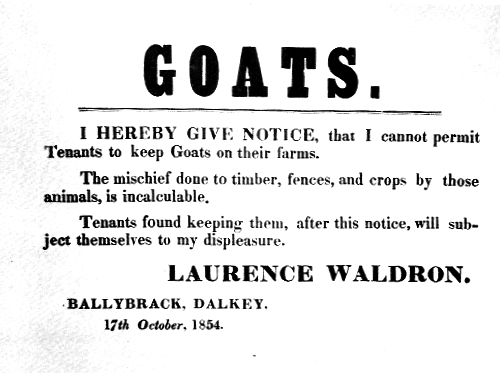
Miscellaneous odd, interesting posters and signs from the aforementioned book The Public Notice. In a sign from 1854 at Dalkey, near Dublin, Laurence Waldron has a peculiarly specific complaint against his tenants:

Goats1854

View original post 491 more words

IMAGINARY ARTISTS V: JOKER

IMAGINARY ARTISTS V: JOKER

Imbecile ward keepers wanted

Imbecile ward keepers wanted

Alistair's avatarADOXOBLOG

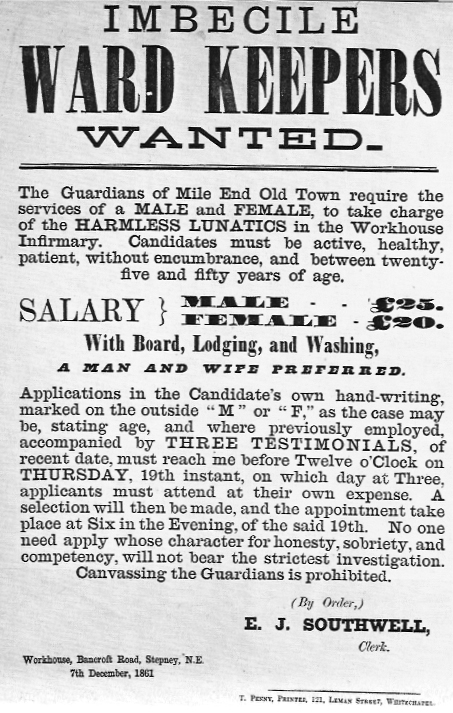
Some scans from The Public Notice (1973, out of print) by Maurice Rickard. It’s a gold mine. First of all, the following poster from late 1861. Despite the ambiguous grammar, they were requesting keepers for a ward of imbeciles, not ward keepers who were imbeciles. Although such terms are now used interchangeably as insults for somebody who’s acting in a way deemed stupid, until well into the 20th century “imbecile” was a respectable diagnosis meaning that a person was more functional than an idiot, but less functional than a moron. In this notice the “imbeciles” are alternatively referred to as “HARMLESS LUNATICS”, which is hardly better. Note also that these poor people (in every sense of the term) were incarcerated in a workhouse, specifically the workhouse of Bancroft Road, Stepney, in north-east London.

ImbecileWardKeepers1861

View original post 251 more words

IMAGINARY ARTISTS III: WARHOL

IMAGINARY ARTISTS III: WARHOL

“Barnaby’s Moon trip– 5p”

“Barnaby’s Moon trip– 5p”

Alistair's avatarADOXOBLOG

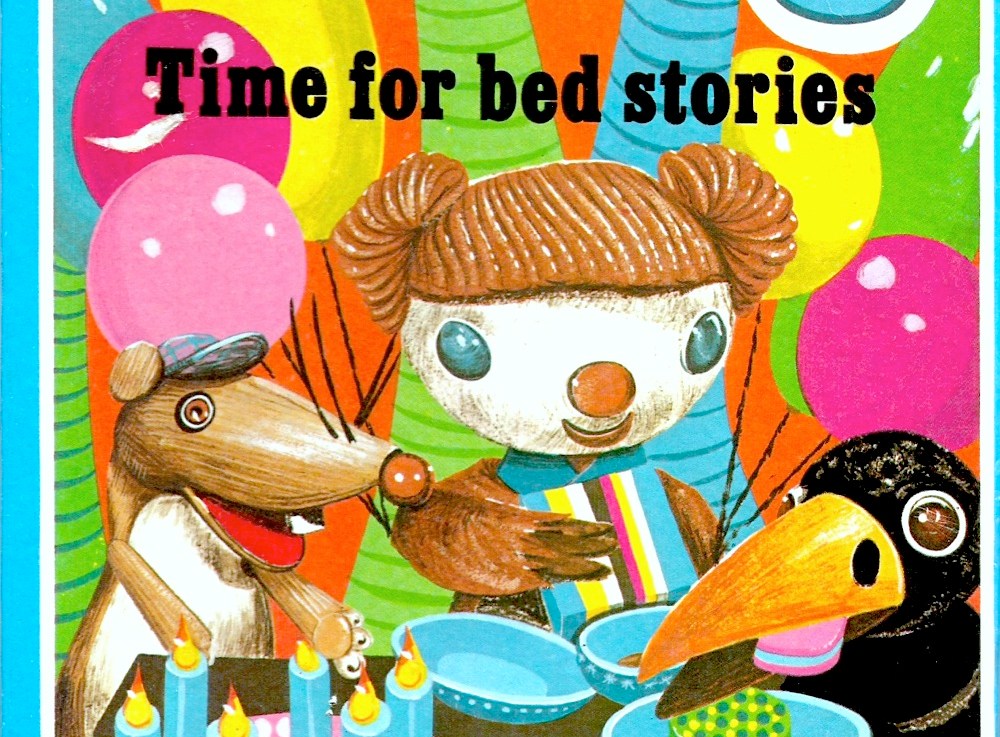
From Barnaby: Time for bed stories, a 1974 children’s book that belonged to me when I was an actual, genuine child. As opposed to the many stupid books I’ve bought since, as an adult. It’s still in my library, currently shelved between a book containing numerous photographs of Viking artefacts and a scientific textbook on human colour perception and cognition. QED.

Talking of colours, what a perfectly 70s palette the book’s cover has. And how hilariously gauche is the slogan “A Dean’s happy times book”.  “Dean’s happy times” sounds like some kind of Withnail & I euphemism, but Dean is the publishing company, not some fellow who just happened to be having a suspiciously happy time making books for children in the 1970s.

Star Wars fans should also have a good look at Barnaby. You think Carrie Fisher pioneered the infamous Princess Leia do? Wrong. Barnaby was rocking the…
View original post 242 more words

Hello sailor

Hello sailor

Alistair's avatarADOXOBLOG

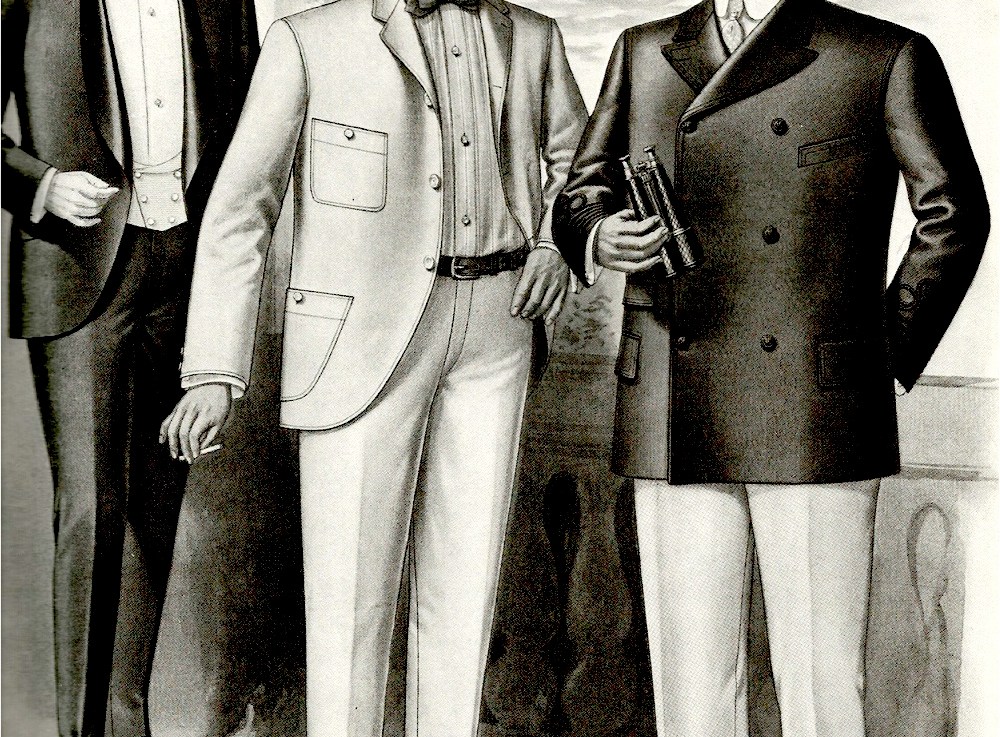
Illustrations from the Jno. J Mitchell Publishing Company’s The Sartorial Art Journal, intended to assist tailors in their consultations with clients about bespoke menswear. I’m assuming they weren’t intended to be but these look rather homoerotic to me, in their own splendidly buttoned-up fin de siécle kind of way. Check out this little cruise:

View original post 30 more words

Kuchisake Onna

Kuchisake Onna

Alistair's avatarADOXOBLOG

Japan panic: the slit-mouthed woman

Stories of 口裂け女, the slit-mouthed woman, emerged from urban Japan in the late 1970s. At first they were particularly passed around between school children, then in the mass media. By the first half of 1979 Asahi Shinbun was highlighting kuchisake onna as a buzzword (hayari kotoba) of the year. In true, random Japanese style one of the others was “rabbit hutches”.

Occasionally Kuchisake onna was reported as a genuine physical threat, a criminal would-be kidnapper or murderer rather than a supernatural being. At times she was somehow both a real world abductor and a folkloric monster simultaneously. (See Hyaku-monogatari for the Edo origins of modern yōkai storytelling) Satoshi Kon’s extremely uneven but in places brilliant series 妄想代理人Mōsō Dairinin [Paranoia Agent] is obviously heavily inspired by the mass hysteria over Kuchisake onna. A woman with long hair and a white…

View original post 462 more words

THE PONZI SCHEME

THE PONZI SCHEME

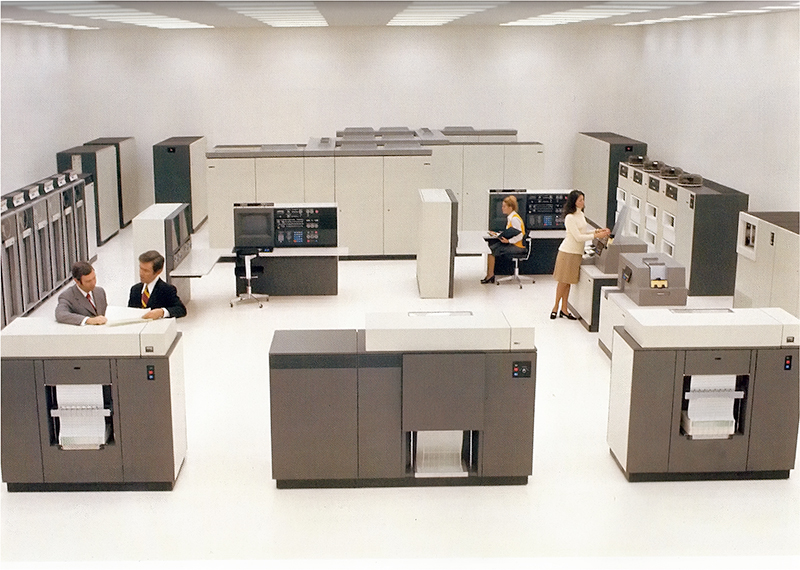
Just a Japanese lady standing awkwardly with a mainframe

Just a Japanese lady standing awkwardly with a mainframe

Alistair's avatarADOXOBLOG

… and another Japanese lady standing awkwardly with a mobile phone.


View original post

The white room

The white room

Colossus

Colossus

Alistair's avatarADOXOBLOG

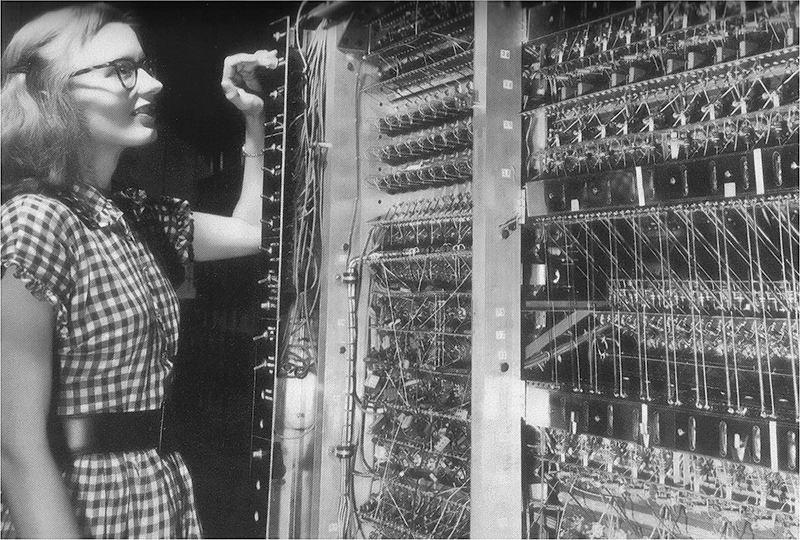
Control panel and plugboards of the British Colossus computer, 1944. It was not programmable, had 2500 vacuum tubes, and it had only one hardwired purpose and algorithm: to crack the encryption of Germany’s Enigma machines, processing up to 5000 characters per second. Based on the work of mathematicians and cryptographers such as Alan Turing at the top secret Bletchley Park facility, the ability to break German codes was one of the factors that eventually turned the Second World War in favour of the Allies.

Another notable thing about this photograph is the strangely timeless/time traveller style of the woman on the left. I think she could walk down the street anywhere in the developed world at any time between about 1930 and 2030 and look like she belongs there.

Colossus

View original post 71 more words